OutreachIQ
Your cold email is being deleted in three seconds — not because your service is wrong, but because it contains nothing the prospect didn't already know about their own business.
Built because spray-and-pray cold outreach is everyone's problem.

Every other outreach tool is solving the wrong problem. They're making the send faster when the bottleneck was always the research. I built OutreachIQ around one uncomfortable truth: the reason cold outreach fails isn't the email — it's that there was nothing worth saying before the email was written. Fix the research. The email writes itself.
Overview
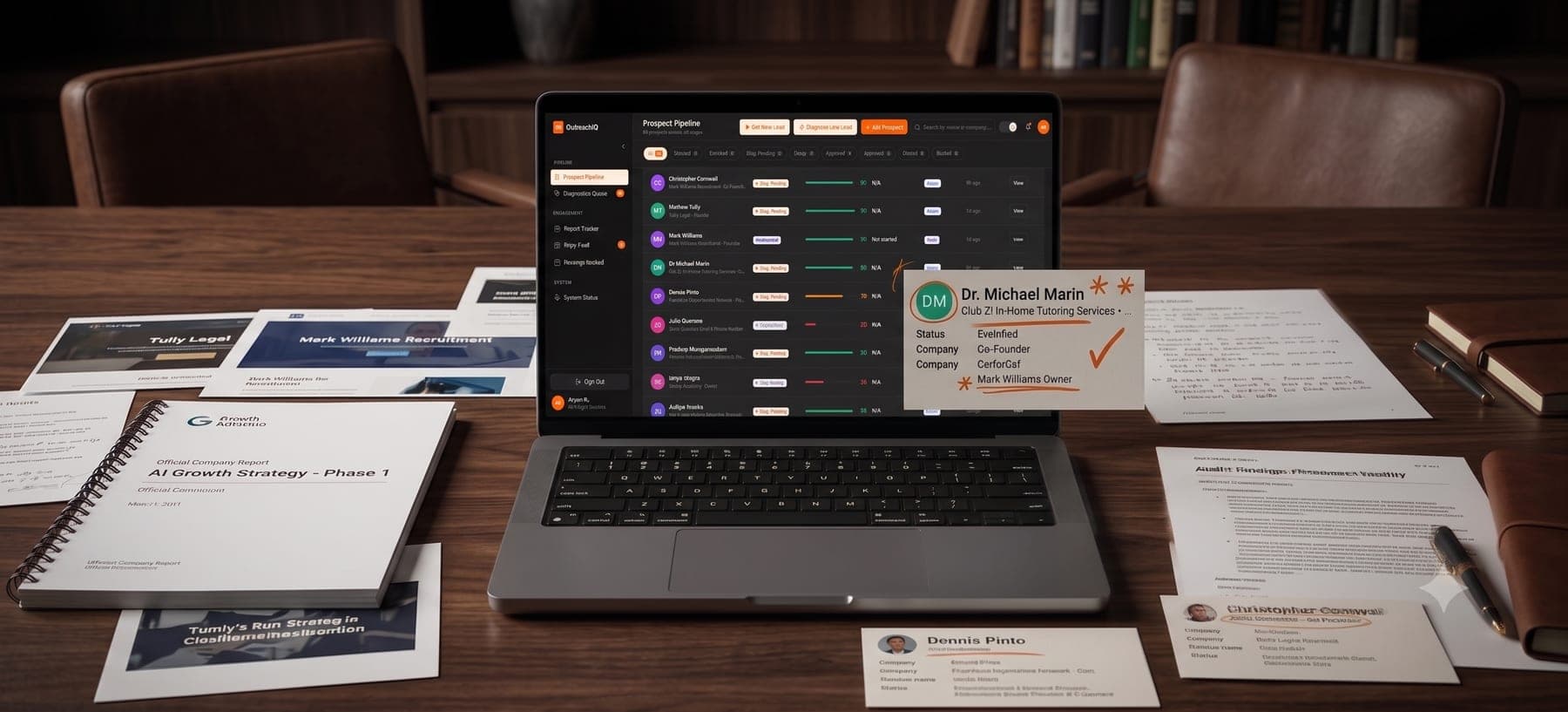
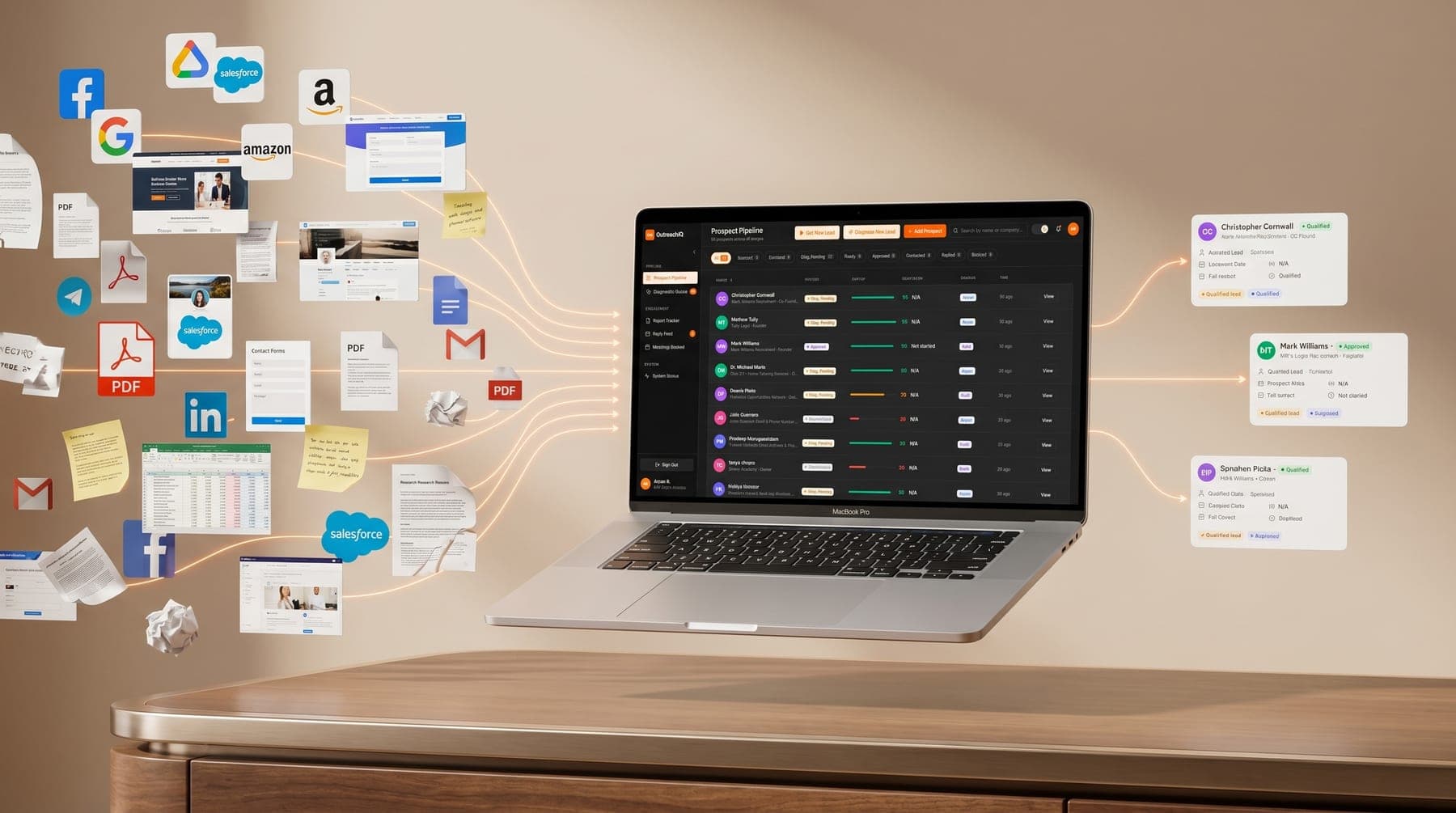
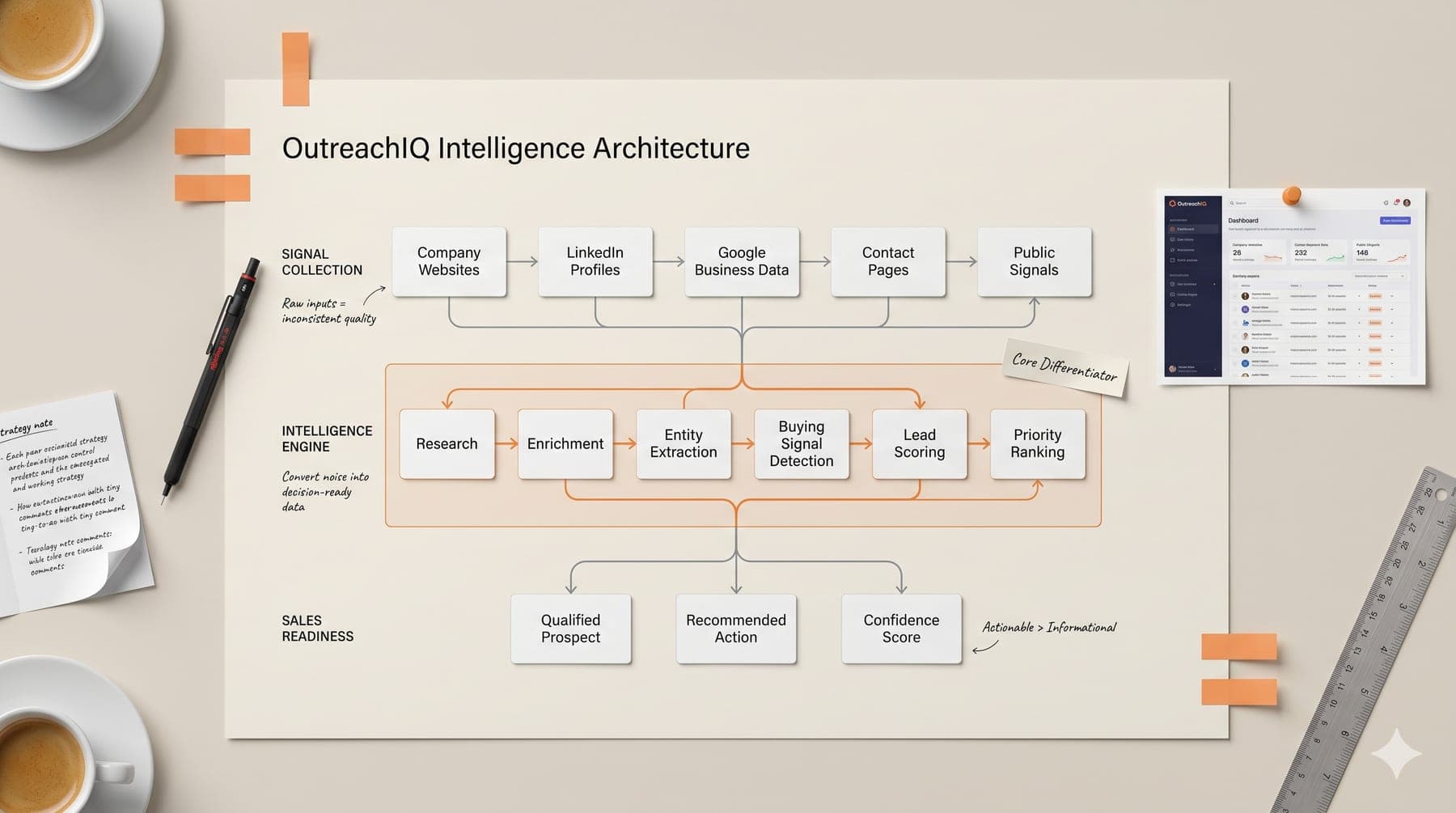
OutreachIQ makes skipping the research structurally impossible. Five automated workflows source companies daily, run a six-API enrichment waterfall, and hand a structured brief to Claude Opus — which browses the actual website, verifies the decision maker, and produces a four-finding consulting-grade diagnostic specific to that company.
The Two-Layer Intelligence Model
Groq handles everything that requires speed and volume — ICP scoring, tech stack gap analysis, founder name extraction from HTML, preliminary bait findings, reply classification. It processes the full prospect list weekly at near-zero cost, running llama-3.3-70b in sequential loops without rate limits. Claude Opus handles everything that requires depth — full web browsing from homepage to blog, contact verification against the live site, four severity-classified findings ordered by impact, and structured JSON output ready for dashboard import. The two models never do each other's job. Groq's fast pass produces a pre-qualified brief. Claude's deep pass replaces that data with verified, specific findings. Together they produce research that is comprehensive, economically viable, and impossible to replicate manually at scale.
The Bait Architecture
Every report is built on a deliberate asymmetry: the Critical finding — the most specific, most surprising observation Claude identified on the prospect's actual website — appears in full. The remaining three findings are blurred behind a single CTA: Book a 30-minute call to see the rest. The prospect has already read something accurate about their own business that no one has ever pointed out to them. The curiosity gap between what they can see and what is locked is what converts the click into a booking. The report isn't a deliverable. It is the close. The email isn't even doing the selling — the research is.
Whatmadeitwork.
If I rebuilt it: I'd add a confidence score to every Claude finding so the human reviewer knows which ones to verify before sending. The system is accurate — but accuracy without a confidence signal puts all the judgment burden on the reviewer.
SpecificEnoughtoFindWhatNoOneNoticed.CarefulEnoughtoCatchWhatWouldHaveBeenCatastrophic.
The first live diagnostic — produced for Caplin and Drysdale, a sixty-year-old Tier 1 Washington DC law firm — found that the firm had no contact form anywhere on its website. A prospective client facing a criminal tax investigation had to browse eighty-plus attorney headshots, self-diagnose their legal situation, and cold-email a stranger before any attorney-client relationship existed. Claude estimated eight to fifteen qualifying matter inquiries lost per quarter. The firm's own team hadn't actioned this in six decades of operation. Claude found it in twenty minutes. The same session caught the error that would have been fatal: Groq had identified the firm's contact as its founder, Mortimer M. Caplin. Claude flagged immediately that Mortimer M. Caplin died in 2019 at age 103. The contact verification layer — built into the system specifically to catch this class of error — worked exactly as designed.